

What Happened to the Nissan Murano Convertible?
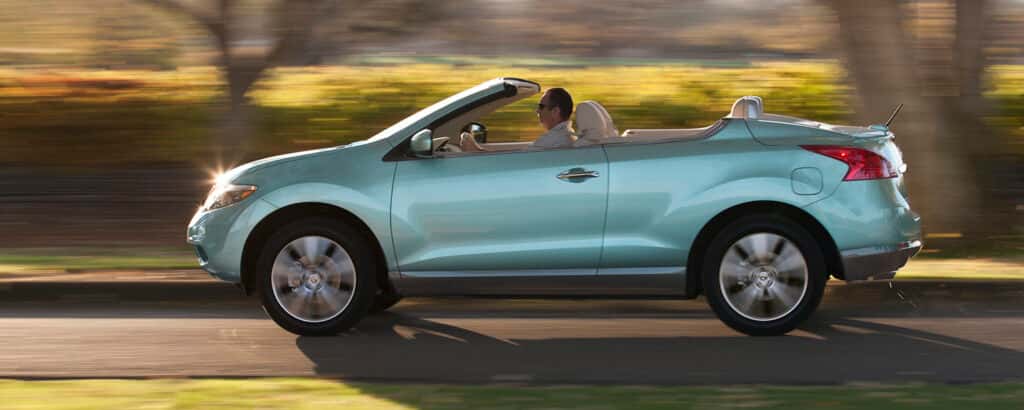
The Nissan Murano convertible stands as one of the most fascinating experiments in recent automotive history. From 2011 to 2014, Nissan built the Murano CrossCabriolet, a vehicle that boldly answered a question almost nobody was asking: what if your midsize SUV could drop its top? This audacious attempt to merge two completely different vehicle categories created something truly unique that split opinions and eventually vanished from dealer lots.
The CrossCabriolet isn’t rolling off production lines anymore, but if you’re wondering what Nissan has cooking today, you can explore our current Nissan SUV lineup right here in the St. Louis metro area.
What Was the Nissan Murano CrossCabriolet?
Picture this: take a perfectly sensible family crossover and chop off its roof. That’s exactly what Nissan did with the Murano CrossCabriolet. Built on the second-generation Murano’s platform, it packed a retractable powered soft-top with a rear glass window, turning a practical family hauler into something nobody had ever seen before.
You still got that high seating position and commanding road view that made the regular Murano popular. But now? Drop the top and suddenly you’re cruising in what was essentially the world’s first mainstream convertible SUV.
This wasn’t some concept car exercise. Nissan engineered this thing for real production and sold it through their dealer network. It came as a 2-door, 4-seater with standard all-wheel drive, powered by a 3.5-liter V6 cranking out 265 horsepower and 248 lb-ft of torque. You got exactly one trim level (LE), complete with 20-inch wheels, woodgrain touches, and cushy front seats.
The convertible SUV lived in automotive no-man’s land that practically nobody else wanted to touch. Its very existence showed Nissan’s willingness to build something completely different, even if it meant confusing the heck out of everyone.
Why Nissan Created the Murano Convertible
The Market Gap Nissan Spotted
Sometimes the best opportunities hide in spaces nobody else thinks make sense. Nissan noticed that zero major manufacturers offered a convertible in the crossover space, which meant potential first-mover advantage. SUVs and crossovers were exploding in popularity while convertible sales kept sliding downward. Maybe combining these trends could pull buyers from both camps?
The thinking went like this: regular convertibles often collected dust during cold months, while SUVs delivered steady utility but zero excitement. What if you could have both experiences in one package? Year-round usefulness without giving up seasonal fun.
This strategy targeted well-off empty-nesters and lifestyle-focused buyers who cared more about driving experience than hauling capacity. Nissan figured these consumers would pay premium money for something truly unique. The bet was simple: exclusivity sells, especially when you’re the only game in town.
Design Thinking and Who They Wanted
Here’s where it gets interesting. Carlos Ghosn, Nissan’s CEO at the time, reportedly kicked off this project after his wife, Rita Kordahi, mentioned wanting a convertible Murano. Talk about executive inspiration hitting close to home.
The design philosophy emphasized bold looks and luxury touches over maximum practicality. Nissan aimed the CrossCabriolet at buyers who saw their ride as a lifestyle statement rather than just transportation. Their target included successful professionals and style-conscious folks who valued exclusivity over everything else.
The company positioned this as a second or third car instead of the primary family vehicle. They knew its quirky nature would appeal to a specific slice of consumers, not mainstream buyers loading up kids and groceries every weekend.
That $46,390 starting price in 2011 reinforced its spot as a luxury specialty item rather than a volume play. This wasn’t about selling thousands of units. It was about offering something nobody else could.
A Timeline of the CrossCabriolet’s Production
The Nissan Murano CrossCabriolet’s journey from concept to discontinued model lasted just five years:
| Model Year | Key Events |
| 2010 | Premiered at Los Angeles Auto Show |
| 2011 | Production began; new front grille, LED taillights, refreshed bumpers; Graphite Blue color added; 20-inch wheels; powered soft-top |
| 2012 | Touchscreen GPS and Bluetooth added as standard |
| 2013 | New wheels and two new body colors; slight price drop |
| 2014 | No changes; production ended with no replacement |
The 2010 Los Angeles Auto Show debut created serious buzz. Car journalists and enthusiasts couldn’t stop debating whether a convertible SUV made any sense at all. Love it or hate it, everyone had an opinion.
Production kicked off for 2011, putting the CrossCabriolet in showrooms as one of the most distinctive vehicles Nissan had ever built. Updates for 2012 focused on tech, adding touchscreen GPS navigation and Bluetooth as standard gear. For 2013, Nissan rolled out styling tweaks and new colors while cutting the price slightly.
The 2014 model year brought zero changes. Production quietly wrapped without a successor, marking the end of Nissan’s convertible SUV experiment.
Features That Made the Murano Convertible Unique
Building a Convertible SUV
Turning an SUV into a convertible required far more than just chopping off the roof. Nissan’s engineers had to completely rethink structural integrity. They installed rollover bars for safety and beefed up the body to compensate for losing roof rigidity. The independent all-wheel suspension got CrossCabriolet-specific tuning to handle the different weight distribution.
That retractable powered soft-top was the most complex piece of the puzzle. Unlike simple convertible mechanisms, the CrossCabriolet’s roof included a rear glass window for better visibility when closed. The electric system let drivers open or close everything with a button press, though all that machinery added significant weight and complexity.
Every CrossCabriolet came with standard all-wheel drive. This gave it year-round traction that most convertibles simply don’t offer. The 3.5-liter V6 provided decent power for the heavier convertible platform, though the extra weight hurt both acceleration and fuel economy compared to a regular Murano.
Looks and Interior Details
The CrossCabriolet’s exterior kept recognizable Murano DNA while incorporating major changes needed for convertible duty. That 2-door layout meant longer doors for back-seat access, creating proportions that looked quite different from the standard 4-door Murano. LED taillights, an updated front grille, and revised bumpers helped set it apart visually.
Inside, everything reflected the luxury positioning. Woodgrain trim warmed up the cabin while plush front seats emphasized comfort over sport. The 4-seat setup ditched the standard Murano’s middle rear seat, creating more room for the two remaining back passengers.
But here’s the catch: that convertible top mechanism ate into cargo space. You still got the elevated seating position from the standard Murano, delivering that commanding view SUV buyers love. Yet the practicality took a hit compared to what people expected from an SUV.
This higher perspective made the CrossCabriolet genuinely different from traditional convertibles. Open-air driving from an SUV height created a unique experience that you couldn’t get anywhere else.
Why the Nissan Murano Convertible Was Discontinued
Price Tag Problems in a Tiny Market
That $46,390 base price in 2011 created serious headwinds. The CrossCabriolet cost way more than a standard Murano while competing against established luxury convertibles and premium SUVs. Shoppers in this price range had tons of alternatives, many from luxury brands with stronger prestige than Nissan carried at the time.
The premium pricing shrunk an already narrow audience even further. Think about it: you’re asking someone to spend luxury money on a Nissan that looks like nothing else on the road. Some buyers loved that uniqueness. Many others wanted safer choices for their hard-earned cash.
The modest price cut for 2013 acknowledged these market realities but didn’t dramatically expand the customer base. As the CrossCabriolet aged without major updates, the business case for continuing production got weaker each year.
Real-World Issues and Buyer Doubts
Those 2 doors created practical headaches that scared off potential buyers. Sure, longer doors gave back-seat access, but the process was clunky, especially in tight parking spots. This design choice put styling over convenience, which limited appeal to buyers who sometimes needed rear passengers.
Rear visibility became another issue. When the top was up, sight lines differed significantly from regular SUVs. The structural components needed for a safe convertible made visibility worse compared to the standard Murano’s design. Drivers had to adjust their habits, and not everyone wanted that hassle.
Cargo space took a major hit because of engineering compromises. That retractable top mechanism ate up space that could’ve been used for storage, limiting the vehicle’s usefulness for trips requiring serious luggage. These practical limitations reinforced the perception that the CrossCabriolet was a lifestyle choice rather than sensible transportation.
Sales Numbers and the Production End
Nissan never broke out specific CrossCabriolet sales figures, but industry watchers noticed limited market uptake from day one. Dealer inventory moved slowly compared to other Nissan models. Production stayed modest throughout the four-year run, and the lack of a replacement when it ended in 2014 told the whole story.
The CrossCabriolet absolutely nailed its goal of standing apart from competitors. Problem was, this uniqueness didn’t translate into sustainable sales. Buyers appreciated the vehicle’s boldness in theory but hesitated when it came time to sign papers. They picked more conventional alternatives that better matched their actual needs and budgets.
The decision to end production reflected basic business reality. Without strong sales, continued investment in updates couldn’t be justified. Nissan moved those resources toward models with broader appeal and stronger market performance.
What Nissan Learned From the CrossCabriolet Experiment
The CrossCabriolet experience taught Nissan valuable lessons about balancing innovation with market demand. Car companies need distinctive products to stand out in crowded markets. But vehicles ultimately have to deliver value propositions that resonate with enough buyers to justify production costs.
Engineering capability alone doesn’t guarantee market success. The CrossCabriolet proved that Nissan could build pretty much anything they set their minds to. Converting an SUV into a safe, functional convertible required serious technical expertise. Yet all that capability meant nothing without customers willing to buy the result.
Nissan also learned about niche positioning and pricing strategy. The CrossCabriolet’s premium price created luxury expectations that needed to be met across every aspect of the vehicle. Meeting those expectations while managing development costs for a low-volume model created challenges that hurt overall competitiveness.
Sometimes the most interesting automotive stories come from vehicles that don’t achieve commercial success. The CrossCabriolet generated massive attention and discussion, boosting Nissan’s reputation for boldness even as sales disappointed. That brand value has worth, even if it doesn’t show up directly in quarterly reports.
Explore Today’s Nissan SUV Lineup at AutoCenters Nissan
While the Nissan Murano convertible remains a fascinating footnote in automotive history, Nissan’s current SUV lineup offers compelling options for St. Louis-area drivers seeking practicality, style, and modern tech. From the compact Rogue to the three-row Pathfinder and the continuing standard Murano, today’s Nissan crossovers deliver the versatility that makes this segment so popular.
We keep over 1,000 vehicles at our Herculaneum location. That includes new Nissan models with complimentary lifetime warranties and an extensive selection of pre-owned vehicles across various makes. While used CrossCabriolet availability depends on market conditions, our team can help you find the right vehicle for your needs.
Want to learn more about what Nissan offers today or discuss your specific transportation needs? Contact our team at AutoCenters Nissan. We’re here to help you find the perfect vehicle for your lifestyle here in the St. Louis metro area.
0 comment(s) so far on What Happened to the Nissan Murano Convertible?